
YouTube Monetization Rules: Every Creator Should Know

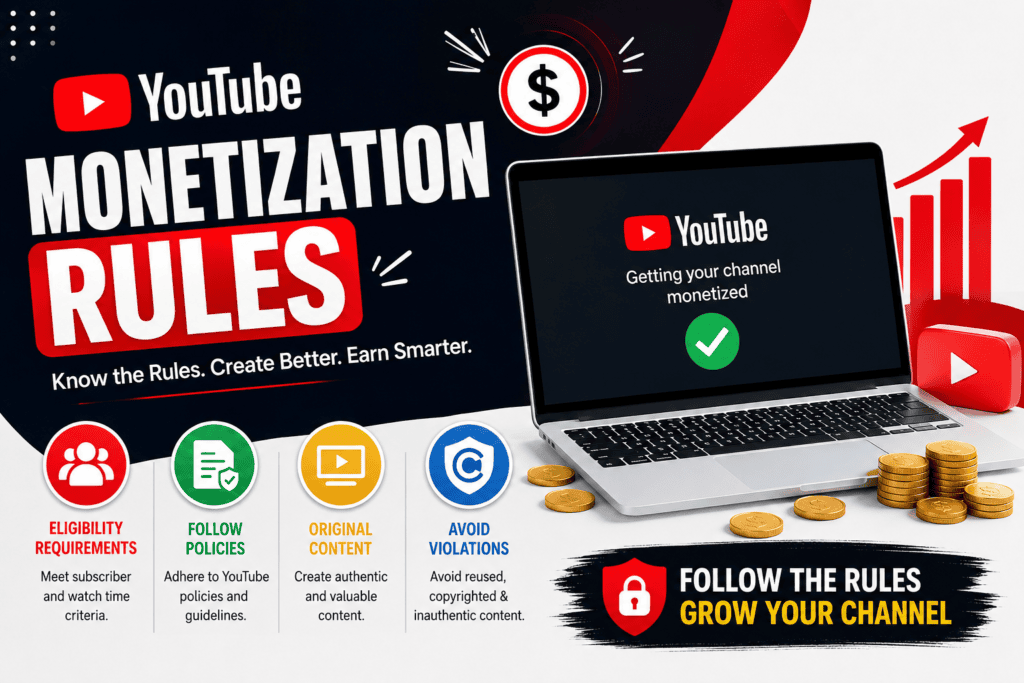
Table of Contents
YouTube monetization
YouTube has become one of the most popular platforms for creators to build an audience and earn money online. However, getting views and subscribers is only one part of the journey. To earn through the YouTube Partner Program (YPP), creators must also follow YouTube’s monetization policies.
The YouTube monetization rules have become especially important as the platform continues to focus on original, authentic, and valuable content. In July 2025, YouTube clarified its policy around repetitive and mass-produced content by renaming “repetitious content” as “inauthentic content.” YouTube stated that this type of content was already ineligible for monetization; the update was mainly intended to clarify the policy.
So, what are new rules of YouTube monetization that may impact you? The biggest areas to understand are eligibility requirements, original content, reused content, repetitive content, copyright, and advertiser-friendly guidelines.
Let’s break them down in simple language.
What Are the YouTube Monetization Rules?
The YouTube monetization rules determine whether a creator can earn money from content through the YouTube Partner Program.
YouTube reviews channels against its monetization policies rather than simply approving them because they have reached a subscriber or view target.
For full YPP eligibility, a creator generally needs:
- 1,000 subscribers and 4,000 valid public watch hours in the last 12 months, or
- 1,000 subscribers and 10 million valid public Shorts views in the last 90 days.
- No active Community Guidelines strikes.
- Two-step verification enabled.
- Access to advanced features.
- An active AdSense for YouTube account.
- Compliance with YouTube’s monetization policies.
Importantly, reaching these numbers does not automatically guarantee approval. YouTube reviews the channel before accepting it into the Partner Program.
YouTube Monetization Eligibility: Is There an Earlier Entry?
Yes. YouTube also has an expanded Partner Program that can give eligible creators earlier access to features such as fan funding and selected Shopping features.
Creators may qualify at:
- 500 subscribers
- 3 valid public uploads during the previous 90 days
- 3,000 valid public watch hours in the previous 12 months or
- 3 million valid public Shorts views during the previous 90 days.
However, this lower threshold should not be confused with the full advertising-revenue threshold.
The higher threshold of 1,000 subscribers plus either 4,000 watch hours or 10 million Shorts views is still relevant for features such as Watch Page ads, Shorts Feed ads, and YouTube Premium revenue.
New YouTube Monetization Rule: Inauthentic Content
One of the most important changes creators should understand is YouTube’s clarification around inauthentic content.
In July 2025, YouTube renamed its “repetitious content” policy to “inauthentic content.” The purpose was to make it clearer that repetitive or mass-produced content is not eligible for monetization. YouTube also stated that there was no change to its reused-content policy.
This matters because some creators use templates to produce large numbers of videos quickly.
For example, a channel could face monetization problems if it repeatedly publishes videos with:
- Almost identical scripts
- Minimal changes between videos
- Automatically generated narratives
- Repetitive slideshows
- Scrolling text with little educational or entertainment value
- Mass-produced videos using similar templates
The important point is not simply whether a creator uses AI or a template. Instead, the content should provide meaningful original value and should not appear mass-produced or interchangeable.
Does AI Content Affect YouTube Monetization?
AI itself is not automatically a reason for demonetization.
The bigger concern is how AI is used.
For example, using AI as a tool for brainstorming, research, editing, or improving production does not automatically make a video ineligible.
However, creators should be careful with channels that publish large numbers of nearly identical AI-generated videos without meaningful original input.
YouTube specifically includes AI-generated content made with generic or unoriginal templates among examples of content that may violate its inauthentic-content guidelines.
Therefore, if you use AI, add your own:
- Commentary
- Analysis
- Storytelling
- Experience
- Opinions
- Educational value
- Creative editing
In simple terms, use AI as a tool, not as a replacement for originality.
Reused Content: Another Major Monetization Risk
Reused content is different from inauthentic content.
Reused content refers to material taken from YouTube or another online source without adding significant original commentary, modification, or educational or entertainment value.
For example, simply uploading:
- Movie clips
- Other creators’ videos
- Social media compilations
- Sports clips
- TV footage
may create monetization problems if you have not transformed the material sufficiently.
However, YouTube does allow some transformed content.
Examples can include:
- Critical reviews using clips
- Reaction videos with meaningful commentary
- Sports analysis
- Edited footage with a new storyline and commentary
- Movie scenes with rewritten dialogue and changed voiceover.
Remember that monetization approval and copyright are separate issues. Even if content qualifies as transformed under the reused-content policy, copyright rules can still apply.
Copyright and YouTube Monetization
Copyright is another important part of the YouTube monetization rules.
Creators need the necessary commercial rights to use the audio and visual elements in their videos. YouTube states that creators are responsible for ensuring they have the required rights, including rights to third-party material.
This is especially important for:
- Music
- Movie clips
- TV footage
- Stock footage
- Images
- Other creators’ content
Using copyrighted material without appropriate rights can result in claims, restrictions, or other consequences.
Therefore, before uploading a video, ask yourself: Do I have the right to commercially use everything in this video?
Advertiser-Friendly Content Still Matters
Getting accepted into YPP does not mean every video will necessarily receive the same advertising treatment.
YouTube has advertiser-friendly guidelines that influence whether advertisers are comfortable placing ads on particular videos.
Additionally, YouTube improved its ad-suitability review process in 2025. Some videos undergoing checks may receive an additional review, including human review, and monetization decisions can sometimes take up to 24 hours.
Therefore, creators should focus on making content that is suitable for both viewers and advertisers.
How to Protect Your Channel From Monetization Problems
If you want to build a monetized YouTube channel, follow these practical steps:
1. Create Original Content
Develop your own ideas, scripts, commentary, presentation style, and storytelling.
2. Avoid Mass Production
Do not create dozens of videos that are almost identical simply to increase upload volume.
3. Add Real Value
Teach something, entertain viewers, provide analysis, share experience, or offer a unique perspective.
4. Be Careful With Reused Content
If you use someone else’s material, transform it significantly with meaningful commentary, analysis, education, or entertainment.
5. Check Copyright
Make sure you have the appropriate rights to commercially use music, footage, images, and other third-party material.
6. Monitor Your Entire Channel
YouTube’s monetization review can consider the channel as a whole. Reviewers may look at videos, titles, descriptions, and the channel description when assessing reused content.
What Are New Rules of YouTube Monetization That May Impact You?
The biggest takeaway is that YouTube wants monetized content to be original, authentic, useful, and valuable to viewers.
The 2025 clarification around inauthentic content is particularly important for creators using templates, automation, or AI. The rule does not simply mean “AI content cannot be monetized.” Instead, creators should avoid repetitive or mass-produced content that provides little original value.
Similarly, reused content can still be monetized when the creator adds meaningful transformation, commentary, or value.
Therefore, creators should focus less on producing the maximum number of videos and more on producing content that viewers can recognize as genuinely valuable.
Conclusion
Understanding the YouTube monetization rules is essential if you want to turn your channel into a long-term source of income.
The key requirements include meeting the appropriate YPP eligibility threshold, following YouTube’s policies, avoiding active Community Guidelines strikes, setting up two-step verification and AdSense, and producing content that meets monetization standards.
Most importantly, creators should pay attention to originality. Repetitive, mass-produced, or low-value content can create monetization problems, while meaningful commentary, creativity, education, and entertainment can help make content more valuable.
If you use AI, templates, clips, or other people’s material, don’t focus only on whether you can technically upload it. Focus on whether you are adding enough original value for viewers.
Ultimately, the safest YouTube strategy is simple: create original content, add genuine value, respect copyright, and build a channel that viewers want to return to.
Turn Your YouTube Channel Into an Income Stream
Confused about YouTube monetization rules or how to grow your channel the right way?
Learn YouTube Marketing, Content Strategy, SEO, AI Tools & Monetization Strategies with Vidya Sarthi Digital Marketing Institute.
Learn. Create. Grow. Monetize.
Start your digital marketing journey with Vidya Sarthi Digital Marketing Institute. today!